Artificial intelligence has followed a familiar pattern for most of its commercial life. A user provides input. A model processes it. A response comes back.
Large Language Models raised the ceiling on what that response could be. Suddenly, AI could summarize complex documents, generate sophisticated content, reason through multi-step problems, and hold coherent conversations. The quality of that request-response cycle improved dramatically.
But the pattern itself stayed the same.
Agentic AI breaks that pattern.
Instead of designing a system that answers a request, agentic AI is about designing a system that pursues an objective. The engineering question shifts from "What should the model generate?" to "What should the system do next to move toward its goal?"
That shift changes everything about how these systems are built, governed, and deployed.
What This Looks Like in Practice
Consider a relationship manager at a bank preparing for a credit review. She needs a complete picture of a corporate customer's financial position before tomorrow's meeting.
With a conventional AI assistant, she might paste in a prepared summary and receive a useful analysis. But someone still had to gather that information manually, decide what to include, and hand it to the model.
An agentic system approaches the same task differently.
Given the objective, the system determines what information is relevant. It identifies that it needs recent transaction data, repayment history, credit exposure, account activity, existing risk flags, and relevant internal credit policies. It retrieves what it is permitted to access, examines the results, and decides whether additional context is needed before continuing.
The process is no longer linear. It looks more like this:
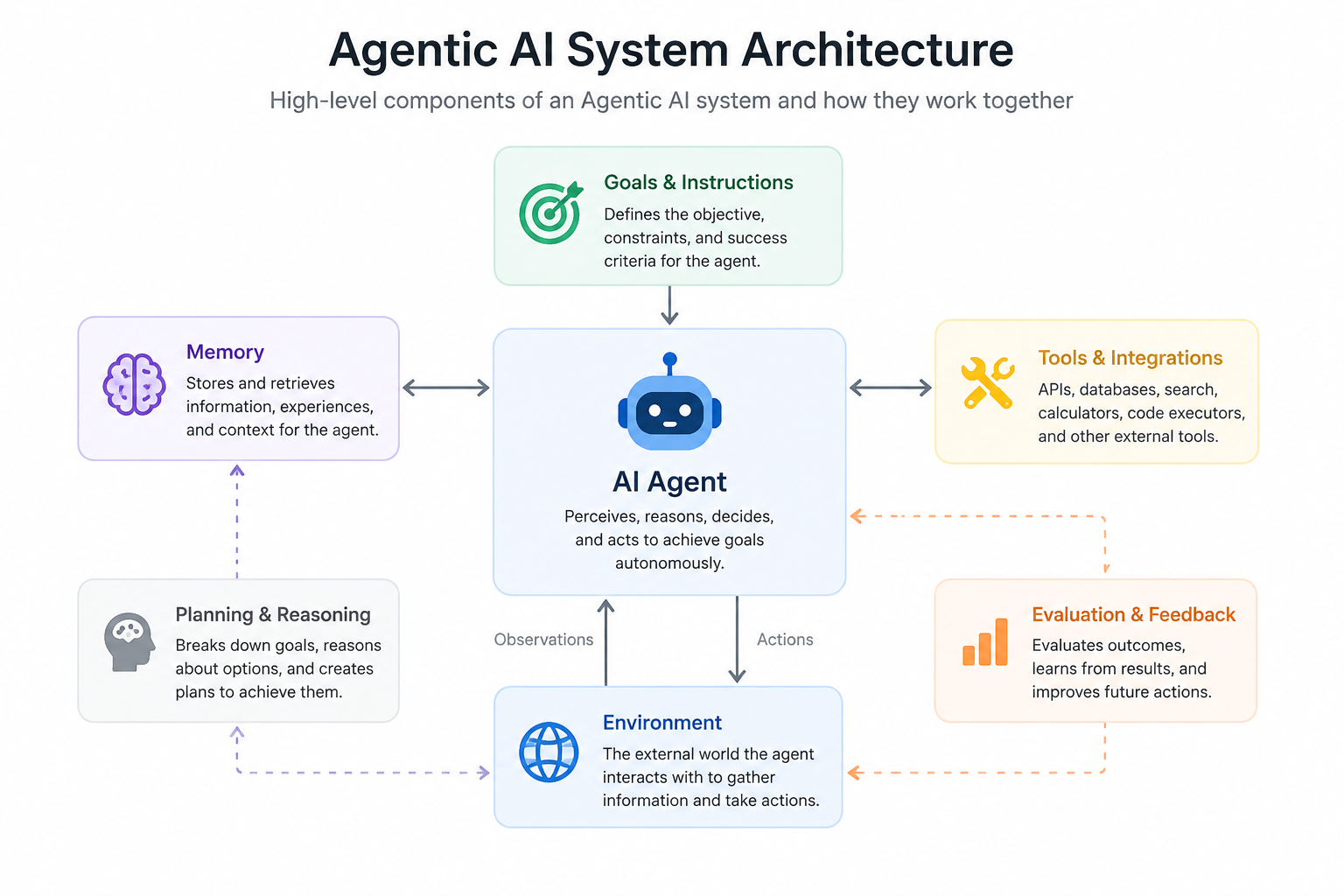
Objective → Understand Current Context → Determine Next Action → Interact with the Environment → Observe the Result → Determine What Happens Next → Outcome
That feedback loop, where the system observes, decides, acts, and adapts, is the defining characteristic of an agentic system.
Agency Is a Spectrum, Not a Switch
Agentic AI is not a single technology or framework. It describes an architectural approach in which an AI-enabled system is given an objective and some degree of authority to determine how to pursue it.
That degree can vary widely.
A narrowly constrained system might only decide which approved data source to query next. A more capable system might coordinate multiple steps across several enterprise services, evaluate intermediate results, and adjust its path as new information becomes available.
This means agency should never be treated as a binary property. Systems exist on a spectrum from fixed, predefined workflows all the way to goal-directed autonomous operation, with many practical configurations in between.
Where a system sits on that spectrum is an engineering and governance decision, not a default.
Controlled Agency, Not Unlimited Autonomy
The word "agentic" can create the impression that AI is now operating independently, without boundaries or oversight. In production environments, especially in regulated industries like banking, that impression is not just wrong, it is dangerous.
Return to the banking scenario.
An agentic system might be appropriately permitted to retrieve approved customer data, analyze account activity, identify anomalies, consult internal knowledge bases, and prepare a recommendation for a human reviewer.
That same system should not automatically be permitted to approve credit, modify a risk classification, block an account, execute a transaction, or communicate a regulated decision to a customer without human authorization.
The goal in production is not maximum autonomy. It is controlled agency: meaningful AI participation in complex workflows, operating within clearly defined boundaries, with proper oversight built into the architecture.
This Is a Systems Engineering Problem
It is tempting to think of an AI agent as a capable language model with a well-crafted prompt.
That view is incomplete.
A production agentic system lives inside a broader software architecture. The model provides reasoning and language capabilities. The surrounding system handles data access, state management, external integrations, authorization, security, failure recovery, observability, and governance.
Even if the model correctly determines that additional customer transaction data is needed, the surrounding system still has to answer harder questions:
- Is this agent authorized to access that data?
- What records may it retrieve?
- What happens if an external service is unavailable?
- How is sensitive information protected?
- Which actions require human approval?
- How can an auditor reconstruct what the system did?
Prompting alone cannot answer those questions. Architecture can.
This is why agentic AI is best understood as the combination of AI capability, software engineering, controlled access to systems, state and context management, security and guardrails, observability, evaluation, and human oversight working together. The intelligence of the model matters, but production reliability emerges from the entire system.
Why It Matters Now
Many real-world problems cannot be solved with a single prompt or a completely predetermined workflow.
The information required may not be known at the start. One finding may determine what to investigate next. A failed step may require an alternative path. A risk threshold may require escalation before work can continue.
Banking is full of these problems.
A fraud investigation evolves as new transaction relationships emerge. A credit assessment requires different evidence depending on the customer, the product, and the risk profile. A regulatory inquiry may require evidence gathered across multiple systems before a human reviewer can reach a conclusion.
Traditional software can orchestrate these processes, but when the appropriate next step depends heavily on context, complex decision trees become difficult to maintain at scale. Agentic AI introduces the possibility of placing AI-driven decision making inside carefully controlled parts of those workflows, not to replace deterministic software, but to handle the adaptive, context-dependent decisions that rigid workflows struggle with.
A New Engineering Paradigm
Agentic AI represents a meaningful shift in what intelligent software can be asked to do.
Traditional software executes explicitly coded instructions. Predictive AI makes inferences from data. Generative AI produces content from context. Agentic AI participates in deciding how goals are pursued.
Each paradigm builds on the previous, and none replaces the others. A mature banking platform might use deterministic software for transaction processing, machine-learning models for fraud scoring, generative AI for summarization, and agentic components for investigative and decision-support workflows.
The engineering discipline is knowing which paradigm belongs where, understanding the trade-offs involved, and designing systems with the appropriate level of intelligence, autonomy, control, and human oversight.
Agentic AI therefore represents more than a new way of interacting with language models. It introduces a new architectural question: how should an AI system perceive its environment, make decisions, take actions, and remain aligned with the objective and boundaries established for it?
Answering that question begins with understanding the fundamental building block of an agentic system: the AI agent.
Share this article
About the author
Raj Kumar
AI Solution Architect, Data Scientist, and AI Engineer focused on building production-ready AI systems, RAG applications, LLM solutions, and practical AI engineering.
Continue exploring
Go deeper into practical AI engineering systems.