Every few weeks, another AI model arrives with improved reasoning, stronger coding capabilities, better multimodal understanding, or lower inference costs. The benchmarks are impressive, and the pace of progress is difficult to ignore. Yet engineering teams deploying these models inside enterprise systems continue to encounter familiar problems: unreliable tool execution, inconsistent structured outputs, retrieval failures, unpredictable latency, escalating costs, and security risks.
This creates an interesting contradiction. If the underlying models are becoming significantly more capable, why does building reliable production AI remain so difficult?
The answer is that model intelligence and system reliability are not the same engineering problem.
Consider this: even if five required operations each succeed 95% of the time, their combined workflow reliability can fall to approximately 77%, assuming independent failures and no recovery mechanism. This is where model capability and production engineering begin to tell two very different stories.
A model might demonstrate exceptional reasoning capabilities in a controlled evaluation and still struggle when connected to enterprise documents, external APIs, legacy applications, changing business rules, and real users. A successful benchmark measures performance under defined conditions. A production environment introduces dependencies, uncertainty, operational constraints, and failure scenarios that the benchmark may never encounter.
Consider a banking AI assistant responsible for reviewing a loan application. It must retrieve the correct lending policy, interpret supporting documents, validate customer information, invoke authorized services, and produce an explainable recommendation. Even if the underlying model answers 99% of a particular evaluation dataset correctly, that result alone cannot establish whether the complete workflow is reliable enough for production.
What happens when the retrieval system returns an outdated policy? What if an API times out after processing a request? What if the model generates a technically valid response using incomplete customer information? And how does the organization detect these failures before they influence a consequential business decision?
These are not problems that can be solved simply by replacing one language model with another.
The next phase of enterprise AI will not be defined only by how intelligent our models become, but by how reliably we engineer the systems around them.
To understand why, we need to examine what recent model advancements actually change, where benchmark performance stops being a useful proxy for production readiness, and which engineering decisions ultimately determine whether an AI application can operate safely, consistently, and economically at scale.
The AI Model Race Has Changed. But What Has Actually Improved?
The AI model landscape is evolving beyond conversational intelligence. Earlier generations demonstrated how effectively language models could answer questions, summarize documents, and generate code. Modern models are increasingly expected to reason through complex problems, interact with external tools, interpret multimodal information, and support workflows that extend beyond a single prompt.
This shift is particularly important for enterprise applications. A model that generates a convincing answer is useful, but a production system must consistently deliver outcomes within defined business, security, and operational constraints.
Consider an AI assistant supporting a banking operations team. Answering a question about a lending policy is only the beginning. The application may need to retrieve the correct policy version, interpret eligibility conditions, access authorized customer information, execute controlled tools, and produce a response that can be verified against the underlying evidence.
Improved model capabilities make these workflows increasingly feasible. However, they also expand the number of interactions and dependencies that engineering teams must manage.
The challenge is no longer simply getting an AI model to generate the right answer. It is ensuring that the entire workflow produces the right outcome, consistently and safely.
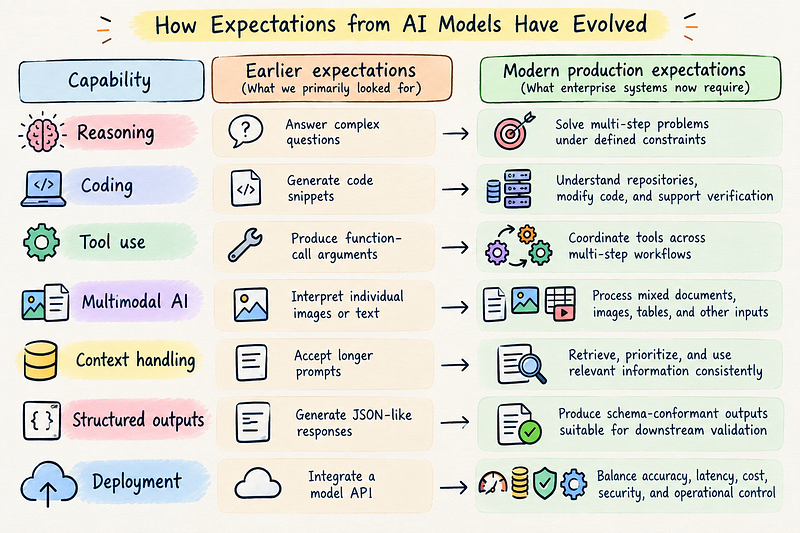
This leads to a more useful question for engineering teams:
Instead of asking which AI model achieved the highest benchmark score, engineering teams need to ask a more practical question: Which model can consistently meet our workload’s quality, cost, latency, security, and reliability requirements?
Recent releases from leading AI providers make this question particularly relevant. They demonstrate how rapidly model capabilities are advancing, but they also reveal why choosing a more powerful model is only one part of building a production-ready AI system.
The Latest AI Model Releases: What Has Actually Changed for Enterprise Engineering?
September 2026 has brought another wave of AI model announcements, with OpenAI, Anthropic, Meta, and the broader open-weight ecosystem pushing capabilities across reasoning, coding, multimodal understanding, tool execution, and inference efficiency.
For AI engineers, however, the interesting story is not simply which model is more powerful. It is how these advancements are changing what we can build, what it costs to operate, and how much responsibility the surrounding application must assume.
As models move beyond generating responses toward executing multi-step workflows, the engineering conversation is shifting from model intelligence alone to execution reliability, operational control, and measurable business outcomes.
OpenAI: From Reasoning to Multi-Step Execution
OpenAI’s GPT-6 Astra announcement highlights progress in coding, computer use, research, and complex multi-step tasks. These capabilities expand opportunities for AI-assisted software engineering and enterprise automation.
However, greater execution capability introduces additional responsibilities. Applications that allow models to interact with external systems require explicit authorization, controlled tool access, execution monitoring, and outcome verification.
As models become more capable of taking action, engineering teams must become more deliberate about controlling those actions.
Anthropic: Intelligence Meets Inference Efficiency
Anthropic’s September announcements include Claude Fable 5.1, Mythos 5.1, Opus 5.5, and Sonnet 5.5.
Alongside capability improvements, Anthropic has emphasized inference efficiency. Its published comparisons report improvements in operating cost and execution speed across selected workloads.
These vendor-reported results highlight an important consideration for production AI: stronger reasoning is valuable, but the cost of delivering that intelligence matters just as much.
For organizations processing thousands of documents or running multi-step agent workflows, model selection must balance output quality, latency, and total operating cost rather than relying on benchmark performance alone.
Meta: Multimodal and Agentic Capabilities
Meta’s Muse family reflects growing interest in multimodal reasoning, coding, computer use, and tool-enabled workflows. Its developments also illustrate how AI systems are expanding beyond conventional text-based interactions.
This matters for enterprise applications because business information rarely exists in one format. Financial documents, for example, combine text, tables, scanned pages, charts, and visual layouts.
Improved multimodal capabilities can help process these inputs, but they do not eliminate the need for source verification, document-level validation, or access controls.
The Open-Weight Ecosystem: Deployment Flexibility
Model ecosystems such as Qwen, Mistral, and DeepSeek continue to expand the alternatives available to enterprise teams.
Depending on licensing and technical requirements, open-weight models can provide greater flexibility over deployment, customization, and infrastructure control. Organizations may evaluate smaller models for classification or structured extraction while reserving more capable reasoning models for complex tasks.
However, self-hosting introduces responsibilities involving inference optimization, capacity planning, security, monitoring, and ongoing evaluation.
Greater deployment control does not automatically translate into lower cost or better reliability.
What These Developments Actually Tell Us
The latest model advancements reveal an important shift. AI models are no longer improving along a single dimension. Reasoning, execution capability, multimodal understanding, inference efficiency, and deployment flexibility are evolving simultaneously.
For enterprise teams, this creates more architectural possibilities, but also more decisions to get right.
A model may demonstrate exceptional reasoning yet struggle with incomplete enterprise data. It may execute complex tool calls while the surrounding application lacks adequate authorization or recovery mechanisms. A smaller model may offer attractive inference costs but introduce additional infrastructure and maintenance responsibilities.
The real competitive advantage is not simply having access to a more capable model. It is knowing how to turn that capability into a reliable, secure, and economically sustainable production system.
That is where benchmark performance and production reality begin to diverge.
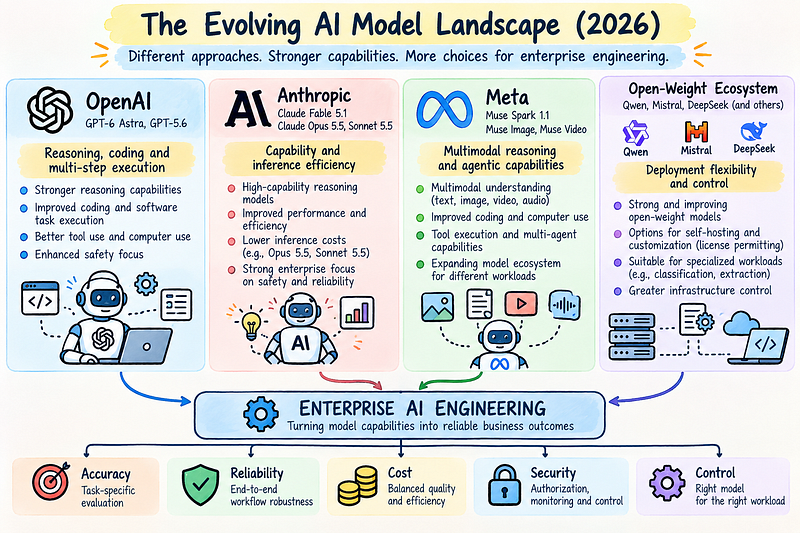
The evolving AI model landscape in 2026. Different model ecosystems are advancing distinct capabilities, but enterprise value ultimately depends on accuracy, reliability, cost, security, and operational control.
The Benchmark Trap: Why Higher Accuracy Does Not Guarantee Production Reliability
Every major model release brings impressive benchmark results. Improvements in reasoning, coding, mathematics, and complex task completion provide useful signals about model capabilities. However, these results can create a misleading assumption: that higher model accuracy automatically produces a more reliable enterprise application.
Benchmarks measure performance under defined evaluation conditions. Production systems must operate with changing inputs, incomplete information, external dependencies, security restrictions, and unpredictable failures.
Benchmark accuracy measures model performance. Production reliability measures whether the complete system delivers the intended outcome.
When Five 95%-Reliable Operations Produce a 77.4%-Reliable Workflow
Consider an AI-powered loan application assistant performing five sequential operations:
- Extract information from submitted financial documents.
- Retrieve the applicable lending policy.
- Validate information against customer records.
- Evaluate eligibility using authorized business rules.
- Generate a structured recommendation supported by evidence.
Suppose, purely for illustration, that each operation succeeds with 95% reliability.
If all five operations must succeed, failures are independent, and no recovery mechanism exists, the probability of completing the entire workflow successfully becomes:
0.95 × 0.95 × 0.95 × 0.95 × 0.95 = 77.4%
This is a simplified mathematical example, not a prediction of real production performance. Actual workflows include correlated failures, deterministic components, validation, retries, and recovery mechanisms. Nevertheless, it demonstrates why strong component-level performance does not automatically translate into equivalent end-to-end reliability.
The lesson is simple: reliability must be engineered and measured across the complete workflow, not inferred from the performance of its individual components.
A model might interpret a financial statement correctly but retrieve an outdated lending policy. It might identify the appropriate eligibility criteria but receive incomplete information from an external service. It could complete every intermediate step and still generate a recommendation that violates the required business rules.
In a regulated environment, any one of these failures may make the final result unsuitable for downstream use.
A Correct Answer Is Not Always a Correct Business Outcome
Imagine a customer asking a banking assistant:
“Am I eligible for a higher credit limit based on my current account activity?”
The model may generate a convincing explanation, but the application must first establish whether the customer is authenticated, the information is current, the correct eligibility policy applies, and the requested recommendation is authorized.
A well-reasoned response based on outdated evidence can still be wrong. Similarly, a factually correct answer does not automatically establish that the application was authorized to provide it.
Production correctness therefore requires more than reasoning quality. It requires valid evidence, appropriate permissions, controlled execution, and business-rule validation.
Evaluate Complete Workflows, Not Just Model Responses
Public benchmarks are useful for identifying candidate models, but they cannot replace evaluation against the workload an organization actually intends to deploy.
An enterprise evaluation dataset should represent realistic conditions, including conflicting documents, missing fields, outdated policies, malformed tool responses, ambiguous requests, and scenarios where the correct action is to stop or escalate.
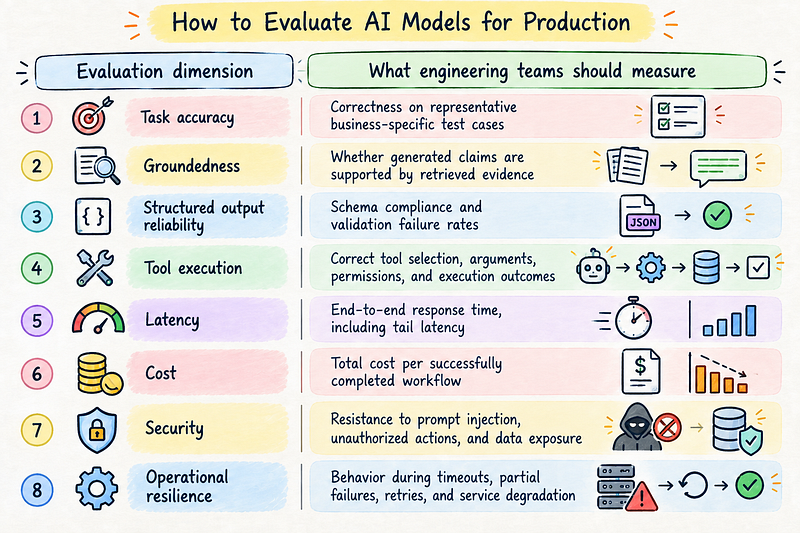
One particularly useful production metric is successful workflow completion: the percentage of executions that reach a verified, policy-compliant outcome without an unresolved error.
For a document-processing system, this means evaluating more than field-extraction accuracy. The workflow must also preserve source evidence, detect inconsistencies, validate its output, and route uncertain cases for human review.
For an AI agent, generating the correct tool call is insufficient. The application must verify that the operation executed successfully and produced the intended effect.
The engineering objective is not to maximize the number of answers an AI system generates. It is to maximize the number of correct, authorized, and verifiable outcomes it delivers.
That distinction leads directly to the engineering challenges that emerge when intelligent models become components of real production systems.
The Hidden Engineering Problems Behind Production AI
A successful AI demonstration often operates under favorable conditions. The model receives relevant context, tools respond as expected, and the application produces an impressive result.
Production is where those assumptions begin to break.
Enterprise AI systems must operate with inconsistent data, changing business rules, legacy applications, external dependencies, security restrictions, and unpredictable user behavior. A failure in any one component can affect the outcome of the entire workflow, even when the underlying model performs exactly as expected.
The challenge becomes even greater when AI systems move beyond answering questions and begin executing actions.
A production AI system is not simply a language model connected to an API. It is a coordinated architecture in which every component must contribute to a correct, authorized, and verifiable outcome.
Seven engineering challenges deserve particular attention.
Retrieval Failures: When Better Reasoning Meets the Wrong Information
Retrieval-Augmented Generation (RAG) connects models with enterprise documents, policies, and knowledge repositories. However, retrieval introduces its own failure conditions.
Consider a banking assistant answering a loan eligibility question. The organization maintains multiple versions of its credit risk policy, each with different effective dates or regional applicability. If the retrieval pipeline selects an outdated policy because it has stronger semantic similarity to the query, even an excellent reasoning model may generate an incorrect recommendation.
Production RAG therefore requires more than semantic search. Document preprocessing, chunking, metadata, hybrid retrieval, reranking, and context assembly all influence the quality of the evidence supplied to the model.
Policy version, effective date, jurisdiction, and access permissions may be just as important as relevance.
When evidence is missing or contradictory, the application should retrieve additional information, request clarification, or escalate rather than manufacture certainty.
Better reasoning cannot compensate for outdated or incorrect evidence.
Tool Execution: Generating the Right Call Is Only Half the Problem
Modern models can select tools and generate structured arguments for external operations. Yet generating a valid tool call does not guarantee successful execution.
Imagine an AI agent updating a customer’s registered contact information. The external API processes the request, but the connection times out before the application receives confirmation.
Should the agent retry?
Blindly repeating the request could create an unintended duplicate operation. Assuming the request failed may also be incorrect.
Reliable execution requires mechanisms such as idempotency keys, execution-state tracking, status verification, bounded retries, and appropriate human approval for high-impact operations.
These controls belong to the surrounding application architecture.
An AI agent should consider an action successful only after its actual outcome has been verified.
Context Engineering: More Tokens Do Not Guarantee Better Decisions
Larger context windows allow models to process substantial amounts of information, but including more content does not automatically improve decision quality.
An enterprise assistant may need to combine user instructions, conversation history, retrieved documents, tool responses, and business rules. Without deliberate context management, important evidence can become buried beneath redundant or conflicting information.
For example, a financial analysis assistant might receive several annual reports, transaction summaries, and historical customer interactions. Including everything may increase inference cost and latency without improving the analysis.
Context engineering determines which information is necessary, how it should be prioritized, when it must be refreshed, and which sources can be trusted.
A reliable context pipeline manages relevance, provenance, freshness, token budgets, and the separation between trusted application instructions and untrusted external content.
Structured Outputs: Valid JSON Is Not Valid Business Data
Structured output generation makes language models easier to integrate with conventional applications. However, schema compliance represents only one layer of correctness.
Consider a bank statement extraction workflow. The model returns valid JSON containing account information, statement dates, opening and closing balances, and transaction details.
Every field might satisfy the required data type while the extracted information remains financially inconsistent. A debit could be classified as a credit, a transaction assigned to the wrong date, or an ambiguous balance silently inferred.
Production validation must therefore extend beyond schema checks. Depending on the workflow, this includes arithmetic reconciliation, cross-field consistency, source-document verification, and human review.
A structurally valid response is not necessarily a factually or financially correct response.
Latency and Cost: Measure the Complete Workflow
A model that performs exceptionally well in an evaluation may require additional reasoning time or computational resources.
In production, these trade-offs affect service-level objectives and operating costs.
Agentic systems make the economics more complicated. A single request may trigger multiple model calls, retrieval operations, reranking stages, external APIs, and validation steps. Retries and unsuccessful executions increase the total cost further.
Engineering teams should therefore measure the complete workflow rather than relying exclusively on advertised token prices.
One useful operational metric is:
Cost per successfully completed workflow = Total workflow operating cost / Number of verified successful completions
Similarly, end-to-end latency should be evaluated against application requirements, including P95 and P99 response times rather than average latency alone.
The objective is not simply to reduce the cost of individual model calls. It is to deliver verified outcomes within acceptable financial and operational constraints.
Security: An Intelligent Model Is Still an Untrusted Execution Component
As AI applications gain access to internal knowledge, customer information, and enterprise tools, maintaining security boundaries becomes critical.
Prompt injection illustrates the problem. Malicious instructions embedded in a retrieved document, web page, or tool response may attempt to influence the model’s subsequent behavior.
A retrieved document should provide information. It should not gain authority to override system instructions, expand user permissions, or authorize external actions.
Security must therefore be enforced through application-level controls, including least-privilege access, tool allowlists, credential isolation, input validation, sandboxed execution where appropriate, approval gates, and auditable action logs.
A model’s ability to recognize suspicious instructions can contribute to defense, but it must not be the sole enforcement mechanism.
Observability and Recovery: Engineering for Failure
Production teams need to understand what happened throughout an AI workflow, not merely inspect its final response.
Effective observability records relevant model versions, retrieved evidence, tool invocations, execution timings, validation results, and workflow outcomes while protecting sensitive information.
Without this visibility, investigating an incorrect answer becomes difficult. The underlying problem may originate in retrieval, context assembly, model reasoning, tool execution, or an unavailable external service.
Recovery is equally important. Applications need defined behavior for timeouts, invalid outputs, exhausted retry budgets, and uncertain execution states.
Depending on the operation, the appropriate response may be a controlled retry, an approved fallback, termination, or escalation to a human reviewer.
A system that fails safely and transparently is more reliable than one that continues generating confident responses when its dependencies are no longer trustworthy.
The Production Reliability Stack
These challenges are interconnected. Retrieval influences context, context influences model decisions, model decisions determine tool requests, and validation establishes whether the resulting outcome is acceptable.
A useful way to visualize this architecture is:
User Request → Authentication & Authorization → Retrieval & Context Assembly → Model Reasoning → Controlled Tool Execution → Business Validation → Verified Outcome
Security, observability, evaluation, and recovery operate across the entire workflow rather than appearing only at its final stage.
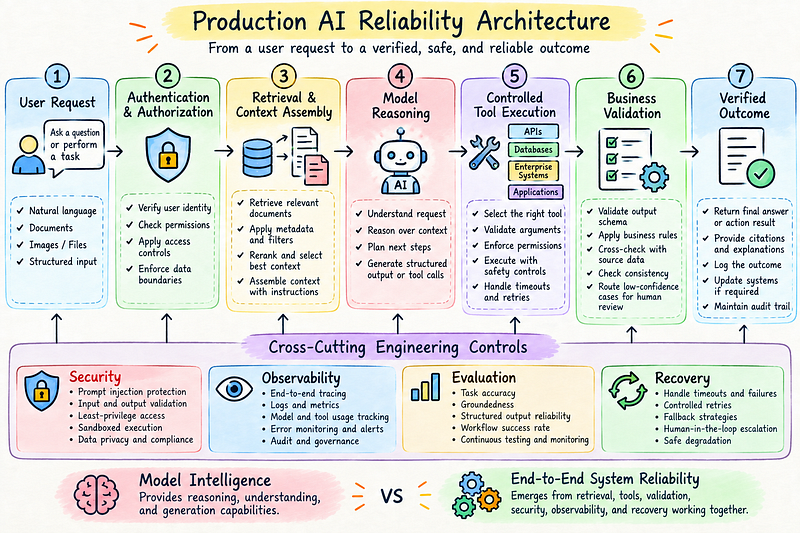
Improving the underlying model can strengthen individual components, but production readiness depends on how the complete architecture behaves under realistic operating conditions.
The model provides intelligence. The surrounding engineering determines whether that intelligence can be used reliably in production.
Proprietary vs. Open-Weight Models: The Enterprise Decision Is More Complicated Than Accuracy
Choosing an AI model for an enterprise application is no longer just a question of which model performs best on a benchmark. Engineering teams must also decide where the model runs, how sensitive data is handled, who manages the infrastructure, and what happens when costs, workloads, or provider capabilities change.
A managed API may offer advanced reasoning capabilities with less infrastructure responsibility. A self-hosted open-weight model may provide greater deployment control and customization flexibility, but introduces additional operational responsibilities. Hybrid architectures offer another possibility, allowing different models to handle different stages of a workflow.
The right decision depends on the workload, not the popularity of a particular model or deployment approach.
Managed Models: Advanced Capabilities with Less Infrastructure Responsibility
Managed model APIs allow engineering teams to integrate sophisticated AI capabilities without independently operating the complete inference infrastructure.
For example, a banking organization developing an internal knowledge assistant might use a managed model for complex policy interpretation and multi-document reasoning while concentrating its engineering effort on retrieval quality, authorization, validation, and auditability.
This convenience introduces external dependencies. Teams must evaluate provider-specific data handling commitments, regional availability, service limits, pricing, model lifecycle policies, and the consequences of API unavailability.
A managed model reduces infrastructure responsibilities, but accountability for the enterprise application’s correctness and security remains with the organization deploying it.
Open-Weight Models: Greater Control, Greater Operational Responsibility
Open-weight models offer additional deployment and customization flexibility, subject to their licenses and technical requirements.
A financial institution might deploy a suitable model within approved infrastructure for document classification, structured extraction, or a narrowly scoped knowledge-retrieval workflow.
This can provide greater control over model versions, deployment configurations, and infrastructure. However, the organization also becomes responsible for inference performance, capacity planning, security maintenance, monitoring, evaluation, and recovery.
Self-hosting does not automatically make an AI system cheaper or more secure. GPU utilization, engineering effort, scaling requirements, and ongoing maintenance all contribute to its actual operating cost.
It is also important to distinguish open-weight from open-source. Publicly available model weights may still carry licensing restrictions that enterprises must review before deployment.
Comparing Deployment Approaches
The decision should be based on measured workload requirements rather than assumptions about model categories.
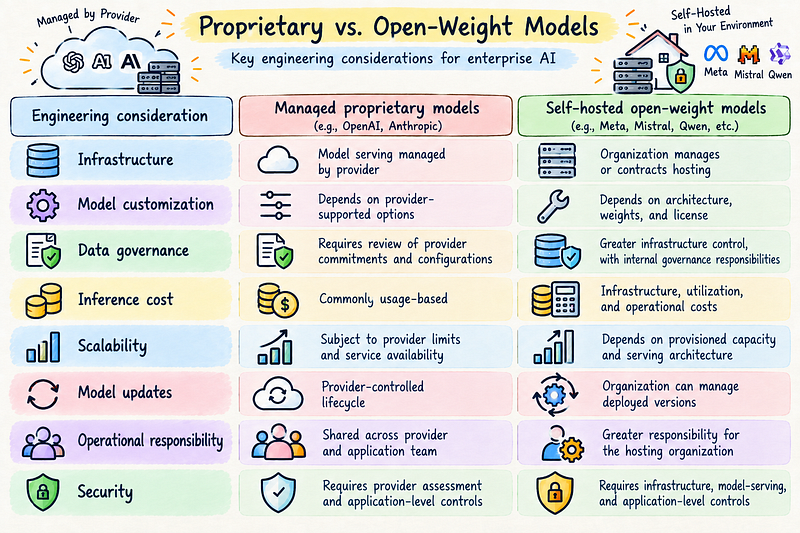
For a low-volume application requiring sophisticated reasoning, a managed model may reduce operational overhead. For a stable, high-volume extraction workload, an appropriately optimized self-hosted model may be worth evaluating.
Neither approach eliminates the need for workload-specific evaluation, security controls, or operational monitoring.
Why Hybrid Model Architectures Matter
Not every operation requires the same level of model capability.
Consider a banking document-intelligence workflow. A smaller, appropriately evaluated model could classify incoming documents and extract straightforward fields. A more capable reasoning model could handle complex interpretation or conflicting evidence, while deterministic application logic validates financial calculations.
Uncertain or consequential cases would be routed for human review.
An orchestration layer can assign these tasks according to predefined requirements, allowing teams to balance capability, latency, and cost without forcing every request through a single model.
However, model routing must also be evaluated. Incorrect routing decisions, fallback failures, and inconsistent outputs can introduce new reliability problems.
Avoiding Vendor Lock-In Without Overengineering
As model offerings evolve, enterprises should consider how easily their applications can adapt to provider or model changes.
Common interfaces for model invocation, structured outputs, tool execution, telemetry, and evaluation can reduce unnecessary coupling. However, abstraction should not hide meaningful differences in reasoning controls, context handling, multimodal capabilities, or tool-calling behavior.
Replacing a model should therefore be treated as a meaningful system change, even when application code remains untouched.
Teams should rerun workload-specific evaluations and validate downstream integrations before introducing a new model version into production.
Ultimately, the objective is not to select one universal model or deployment approach. It is to build an architecture that can use appropriate models for different tasks while preserving reliability, security, cost control, and operational flexibility.
A Banking Reality Check: When a Smarter Model Is Not Enough
Consider a financial institution developing an AI-powered loan document review system. The application processes customer-submitted bank statements, retrieves applicable lending policies, identifies financial inconsistencies, and prepares recommendations for authorized credit analysts.
During development, everything looks promising. The selected model demonstrates strong document understanding, extracts financial information accurately, and produces convincing explanations. The initial demonstration gives the engineering team confidence.
Then the application encounters real production conditions.
A customer submits a scanned bank statement with an inconsistent layout. Another document contains an ambiguous closing balance. The retrieval pipeline selects an outdated lending policy, while an external customer verification API times out after processing a request.
Individually, these may appear to be manageable failures. Together, they expose a much larger problem.
The model may be reasoning correctly over the information it receives, yet the complete workflow can still produce an outcome that is incomplete, unverifiable, or unsuitable for a consequential business decision.
Engineering Reliability into the Workflow
Instead of expecting a stronger model to resolve every failure, the engineering team introduces explicit controls at critical stages.
Document extraction is validated against source evidence. Financial calculations use deterministic checks. Policy retrieval applies version and effective-date constraints. External service calls incorporate controlled retries and execution-state verification.
When information is incomplete or contradictory, the system records the uncertainty and routes the case for human review rather than generating an unsupported recommendation.
The institution also evaluates models according to task complexity. A smaller model may handle straightforward classification, while a more capable reasoning model processes complex cases. Final recommendations remain subject to business-rule validation and authorized review.
The improvement does not come from finding a model that never makes mistakes. It comes from building a system that can identify errors, contain their consequences, and prevent uncertain outputs from becoming unverified business decisions.
Production readiness begins when an AI application can demonstrate not only what happens when everything works, but also how it behaves when something goes wrong.
What AI Engineering Teams Should Do Differently
The latest advances in AI models create opportunities to build more capable applications. However, moving from a promising prototype to a dependable production system requires engineering discipline that extends well beyond model selection.
For teams building enterprise AI applications, five priorities deserve particular attention:
- Evaluate against real workloads. Build evaluation datasets using representative enterprise data, realistic failure conditions, and clearly defined acceptance criteria. Public benchmarks are useful for shortlisting models, but they cannot replace testing against the workflows your organization actually needs to execute.
- Measure verified outcomes, not just model responses. Track successful workflow completion alongside retrieval quality, tool execution, output validity, latency, cost, and recovery behavior. A generated answer should not count as a successful execution unless the intended outcome has been validated.
- Keep critical controls deterministic. Authorization, business-rule validation, financial calculations, and high-impact execution safeguards should remain under explicit application-level control rather than relying on the model’s independent judgment.
- Treat every model upgrade as a system change. A newer model may improve reasoning while changing tool selection, response structure, latency, or operating cost. Run regression evaluations and validate downstream integrations before introducing a new model version into production.
- Make observability and evaluation continuous. Capture production traces, validation results, operational metrics, and failure patterns. Use these insights to maintain evaluation datasets, investigate recurring problems, and improve reliability over time.
The central engineering question should remain consistent:
Can this system repeatedly deliver the intended outcome using authorized information and actions, within acceptable quality, security, latency, and cost constraints?
That is a more meaningful measure of enterprise readiness than model intelligence alone.
Final Thoughts: Smarter Models Raise the Ceiling. Engineering Builds the Foundation.
The pace of innovation across OpenAI, Anthropic, Meta, and the broader open-weight ecosystem is remarkable. Models are becoming more capable at reasoning, coding, multimodal understanding, and executing increasingly complex tasks. These advancements are expanding what enterprise AI systems can achieve.
But there is a fundamental distinction we cannot afford to overlook.
A successful demonstration shows what an AI model can do when conditions are favorable. A production system must demonstrate what happens when those conditions are not.
What happens when retrieval returns outdated information? When a tool executes successfully but its confirmation never arrives? When an API fails halfway through a workflow? Or when the model produces a convincing answer that violates a critical business rule?
These are the moments when engineering matters most.
The next generation of enterprise AI will require more than selecting increasingly intelligent models. It will demand stronger retrieval pipelines, deliberate context engineering, controlled tool execution, deterministic validation, security boundaries, observability, and continuous evaluation.
Ultimately, production readiness is not measured by how impressive an AI system looks when everything works. It is measured by how consistently it delivers verified outcomes and how safely it responds when something goes wrong.
Smarter models raise the ceiling of what AI can achieve. Reliable engineering builds the foundation that makes those capabilities trustworthy in the real world.
I would love to hear your perspective from the engineering side. What has been the hardest part of taking an AI application from a successful prototype into production? Was it retrieval quality, unreliable tool execution, evaluation, cost, security, or something you never anticipated?
If you have worked through these challenges, I hope this article gives you a useful framework for thinking about production AI beyond model benchmarks. The most valuable engineering lessons often emerge when real-world systems challenge our assumptions.
I’ll continue sharing practical insights into Generative AI, RAG, AI Agents, and production AI engineering, with a focus on what it takes to move from promising prototypes to reliable systems.
Thank you for reading. Let’s focus not only on building smarter AI, but on engineering AI systems we can actually trust.
Share this article
About the author
Raj Kumar
AI Solution Architect, Data Scientist, and AI Engineer focused on building production-ready AI systems, RAG applications, LLM solutions, and practical AI engineering.
Continue exploring
Go deeper into practical AI engineering systems.